
|
GATES — USA
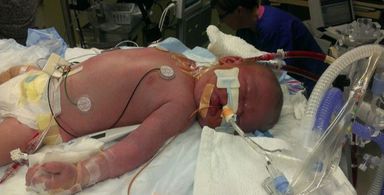
Born 2013 Early-onset Mother's GBS Status: Tested negative Gestational Age: 40 weeks, 1 day Age Harmed: 2 hours after birth |
Gates was born at 40 weeks and 1 day. I had a normal labor and delivery. Labor was about 22 hrs long. My water was intact the entire time. It all seemed very normal and smooth. He nursed just after birth but, 2 hours later he was grunting and unable to latch again. His coloring on his chest and arms was bluish but, we thought he was cold. We didn't know that grunting and not latching was a sign of respiratory distress. We all thought he was just fussing. It continued and I began to get worried.
When the nurse came to make rounds about 2 hours later I told her that he had been making a funny cry for hours and I was worried. She took him to get evaluated by a respiratory therapist. He was born with light meconium staining in the water and the respiratory therapist initially thought the problem was related. They did CPAP for an hour to see if he improved. After an hour and his blood gases worsening they admitted him to the NICU.
When his neonatologist met us the first thing she said was he had pneumonia, sepsis and possibly meningitis. All caused by an infection either Group B Strep or Listeria. That protocol would tell her to do a spinal tap but, she didn't think he would survive it. She started him on antibiotics and intubated him as soon as he arrived in the NICU. He kept losing blood pressure and despite increased efforts his condition continued to deteriorate. At 12 hours old he began to have what they believed were seizures. The sample she had sent to the lab upon his admission began to grow in less than 6 hours. It was group B Strep; she said his body was critically overwhelmed with it.
She transferred us to an ECMO center and at almost exactly 24 hours old his circuit was up and running. He spent almost 6 days on the circuit before being de-cannulated. He spent 11 days total on the ventilator and another 7 on CPAP because one of his lungs was having trouble. He had a total of 21 days of antibiotics to treat the pneumonia, sepsis and possible meningitis.
His ECMO doctor's opinion was that Gates was infected just prior to delivery even though my water was intact. He thought that due to the severity and progression of the infection plus the meconium in the amniotic fluid that it was prenatal-onset. That was his theory though we will never really know when it occurred.
~ Elizabeth, Gates' mom
When the nurse came to make rounds about 2 hours later I told her that he had been making a funny cry for hours and I was worried. She took him to get evaluated by a respiratory therapist. He was born with light meconium staining in the water and the respiratory therapist initially thought the problem was related. They did CPAP for an hour to see if he improved. After an hour and his blood gases worsening they admitted him to the NICU.
When his neonatologist met us the first thing she said was he had pneumonia, sepsis and possibly meningitis. All caused by an infection either Group B Strep or Listeria. That protocol would tell her to do a spinal tap but, she didn't think he would survive it. She started him on antibiotics and intubated him as soon as he arrived in the NICU. He kept losing blood pressure and despite increased efforts his condition continued to deteriorate. At 12 hours old he began to have what they believed were seizures. The sample she had sent to the lab upon his admission began to grow in less than 6 hours. It was group B Strep; she said his body was critically overwhelmed with it.
She transferred us to an ECMO center and at almost exactly 24 hours old his circuit was up and running. He spent almost 6 days on the circuit before being de-cannulated. He spent 11 days total on the ventilator and another 7 on CPAP because one of his lungs was having trouble. He had a total of 21 days of antibiotics to treat the pneumonia, sepsis and possible meningitis.
His ECMO doctor's opinion was that Gates was infected just prior to delivery even though my water was intact. He thought that due to the severity and progression of the infection plus the meconium in the amniotic fluid that it was prenatal-onset. That was his theory though we will never really know when it occurred.
~ Elizabeth, Gates' mom
To learn more about Perinatal & GBS Misconceptions, click HERE.
To learn more about the Signs & Symptoms of Preterm Labor, click HERE.
To learn more about the Signs & Symptoms of GBS Infection, click HERE.
To learn more about Why Membranes Should NOT Be Stripped, click HERE.
To learn more about How to Help Protect Your Baby from Group B Strep (GBS), click HERE.
To learn more about the Signs & Symptoms of Preterm Labor, click HERE.
To learn more about the Signs & Symptoms of GBS Infection, click HERE.
To learn more about Why Membranes Should NOT Be Stripped, click HERE.
To learn more about How to Help Protect Your Baby from Group B Strep (GBS), click HERE.